Regenerative Braking Sim
19/03/2024
In order to calculate the amount of regen we would be capable of producing, I put some work into utilising the data output from OptimumLap and processing it in MATLAB.
The Theory
I initially hit a dead end on how I was supposed to get “requested brake torque” values. But I soon realised that since the only information inputted into OptimumLap that has to do with braking was the tyre friction coefficients, it must be using those to calculate the brake torques and brake pedal position (the value given in the export data).
I couldn’t just assume this however this needed to be validated, hence I set up an OptimumLap simulation that was just a drag strip with an extremely tight curve at the end. What this did is allowed the vehicle to reach max speed, before applying 100% brake torque as the curve was so tight it required a negligible speed to turn the corner. This allowed me to use the deceleration values, along with the weight of the vehicle to calculated the torque on the wheels. Of course due to the downforce of the aerodynamics the torque calculated was higher at higher speeds, but the torque value calculated right at the end of the simulation where the speed was near zero shows the torque as being calculated using the friction coefficients.
Another hurdle before I could calculate regenerative braking estimates was the motor statistics. For some bizarre reason AMK does not provide braking data in their datasheet; despite having blank spaces in the datasheet for them. Whilst this meant we had no concrete data on which to base our regen estimates, for most motors the amount of power regenerated is the same as the amount used to achieve the same amount of torque as braked, at that RPM. What this meant is we could use the torque-rpm and power-rpm graphs to calculate the power returned to the inverter. The majority of the inefficiencies during regenerative braking comes from the inverter (its an inverter it is not meant for rectifying), so we applied an arbitrary (again AMK does not provide this information) 80% efficiency to the inverter rectification.
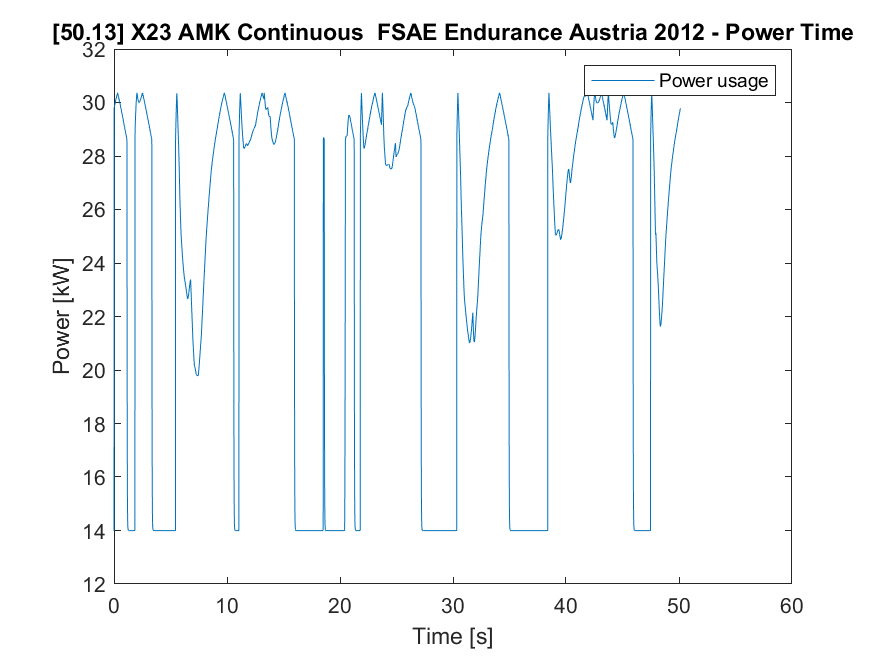
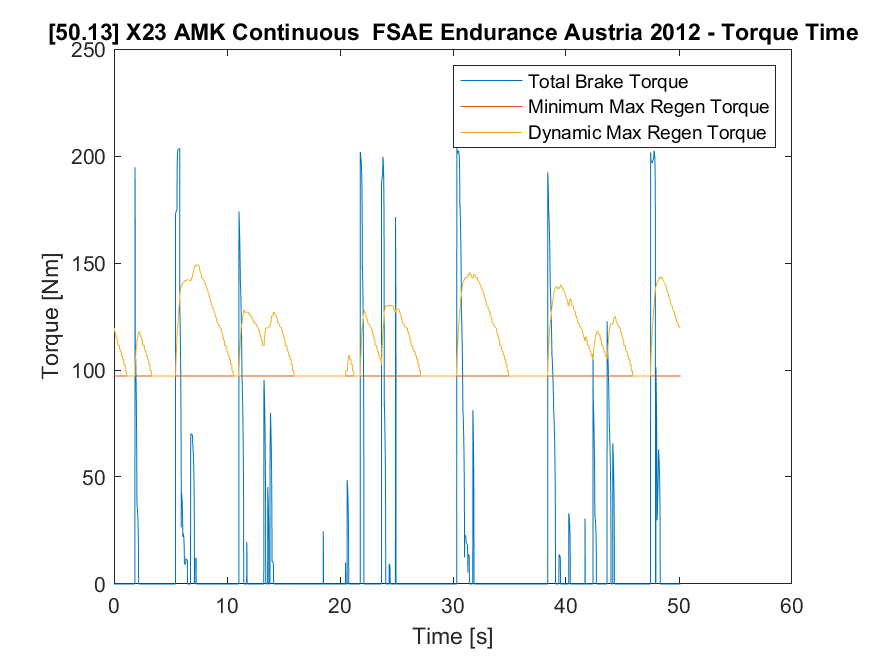
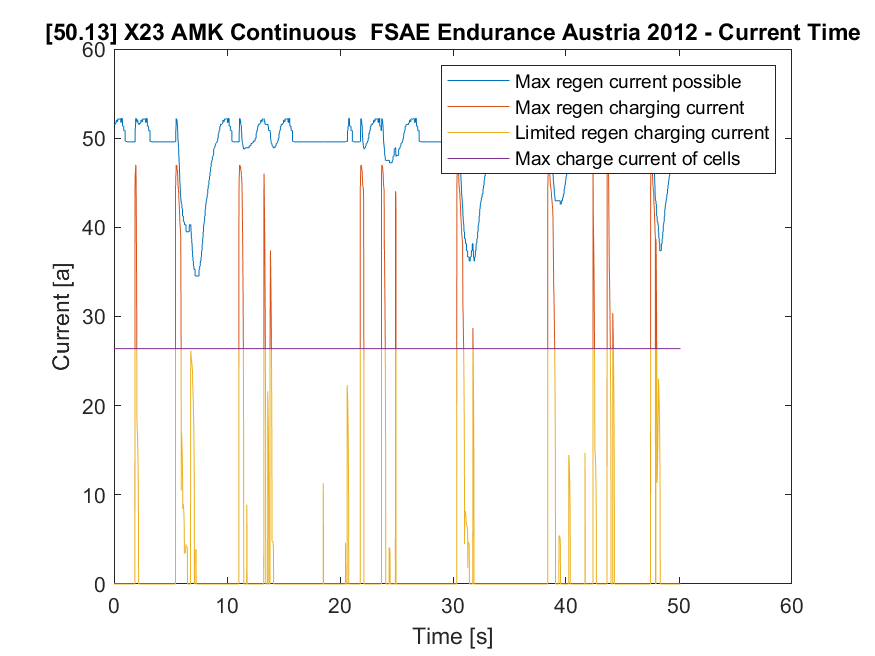
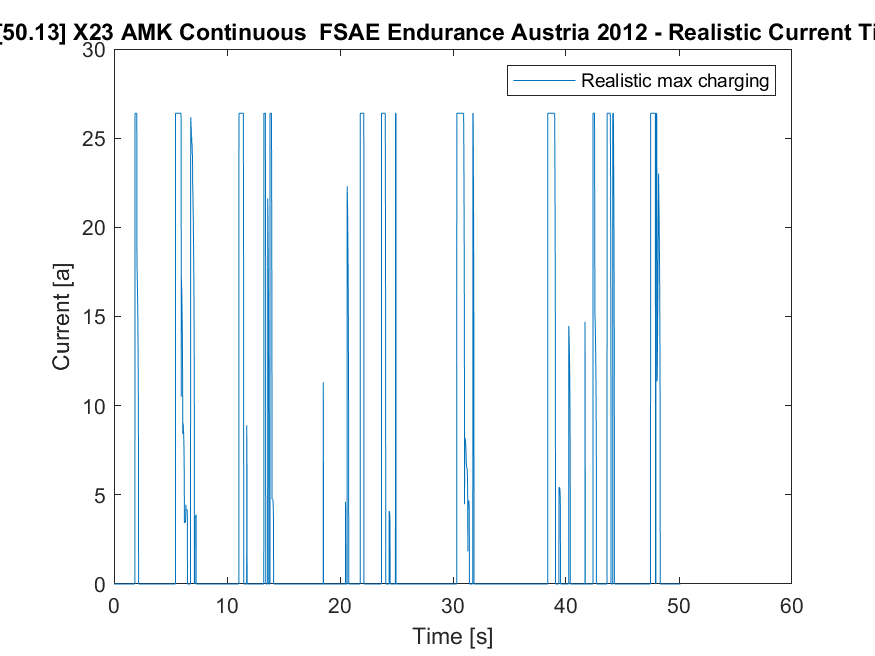
With this information, and the maximum charge rate of the cells in mind, some values could be calculated and plotted as below. The MATLAB script can also be found in the attachments at the bottom of this page.
Results
"powerUsed" ⟼ 326.7826Wh
"expectedRegen" ⟼ 23.5092Wh
"limitlessRegen" ⟼ 33.6483Wh
Limitless regen: regen if we werent limited by the charging current (not really relevant to us)
∴ if not limited, >10% regen, otherwise ~7.2% regen.